When a Routine Fender-Bender Becomes a Lawsuit: What Texas Drivers Actually Need to Know
The Call That Changes Everything
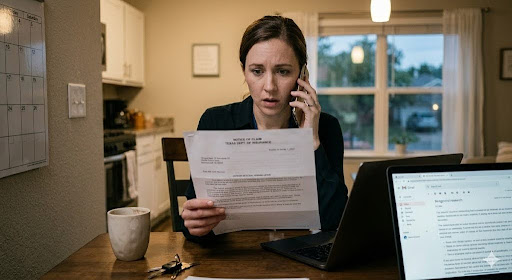
It’s a Tuesday evening, maybe nine o’clock. You’re on your couch, half-watching something on TV, when your phone buzzes. It’s your insurance adjuster—or worse, a number you don’t recognize that turns out to be a law firm. The message is some variation of: we’ve received a demand letter from an attorney representing the other driver in your accident.
Your stomach drops.
The accident was three weeks ago. Forty-five miles an hour on the Dallas North Tollway, stop-and-go traffic, a tap from behind that left a scuff on your bumper and what seemed like a mutual shrug-and-exchange-info moment. You filed a claim. You thought it was over.
This is the moment I’ve watched derail otherwise calm, competent professionals. Not because the situation is necessarily catastrophic—often it isn’t—but because nobody told them what the next sixty to ninety days actually look like. That gap between what people expect and what actually happens is exactly what I want to close here.
What You Expected vs. What’s Actually Happening
Most drivers carry a mental model that goes something like: accident happens, insurance companies talk to each other, someone gets a check, life moves on. That model works fine for property damage claims. It starts to break down the moment someone on the other side retains a boston car accident lawyer or a Texas personal injury attorney and sends a formal demand.
| Standard Insurance Claim | Escalated Legal Claim |
|---|---|
| Claimant deals directly with your insurer | Attorney builds a case that may name you personally |
| You’re largely a background figure | You have active obligations and deadlines |
| Insurer negotiates within policy limits | Damages may include pain, suffering, lost wages, future costs |
| Minimal personal involvement | Discovery, depositions, potential court appearances |
| Typically resolves in weeks | Can take 18 months or longer |
The key distinction worth internalizing: a demand letter is not a lawsuit. It’s a negotiation opener. But it signals that the other side has professional representation and is prepared to file if the number isn’t right. Understanding that distinction is the first step from anxious to informed.
How a Claim Becomes a Lawsuit: The Texas Timeline
Texas gives injured parties two years from the date of an accident to file a personal injury lawsuit—that’s the statute of limitations under Texas Civil Practice and Remedies Code § 16.003. So even if your accident happened months ago and you haven’t heard anything since the initial claim, the clock is still running for the other driver.
This is why “late-appearing” injury claims feel so disorienting. They’re not necessarily fraudulent—they’re often the result of someone finally seeing a doctor, getting a diagnosis, and then consulting an attorney who identifies a viable case.
The typical escalation path:
- The claimant’s attorney sends a demand letter to your insurance company outlining injuries, treatment costs, and a settlement figure
- Your insurer evaluates the demand against your policy limits and the liability evidence
- If negotiations stall after a counteroffer, the attorney files a petition in the appropriate Texas district or county court
- You are formally served—papers handed to you or left at your residence—and the lawsuit is officially underway
- Discovery begins: interrogatories, document requests, depositions
From service, you generally have twenty days to respond in Texas. Your insurance company’s defense attorneys handle this. But here’s what trips people up: you need to forward those papers to your insurer immediately. Sitting on them, even for a few days, can create complications that didn’t need to exist.
Understanding Who Does What—and Why It Matters
Confusion about who controls what is one of the most common sources of panic I see. Let’s be direct.
Your insurance company has a contractual duty to defend you and to pay settlements or judgments up to your policy limits. They assign a defense attorney at no additional cost to you. What they control: litigation strategy, settlement negotiations, and day-to-day case management. What they don’t control: whether the claimant’s attorney files, what damages are claimed, or whether the case goes to trial.
The personal injury attorney on the other side is working on contingency—they only get paid if they recover money. Their job is to prove liability and damages. Their demand letter is a business communication, not a personal attack, even when it reads like one.
You, as the defendant, have more agency than you probably realize.
You can communicate openly with your assigned defense attorney. You have the right to be informed about settlement offers before they’re accepted. In Texas, if a settlement offer exceeds your policy limits, your insurer has an obligation to seriously consider it—and if they don’t and a verdict comes in above your limits, that’s a separate legal issue involving bad faith that your own attorney can address.
Worth knowing: The statute of limitations isn’t just a technicality. It’s a hard deadline that, if missed, can extinguish a claim entirely. Personal injury filing deadlines vary by state—California uses two years as well—and Texas mirrors that standard for most auto accident cases. If you’re ever uncertain whether a claim against you is time-barred, raise it with your defense attorney early.
“But It Was Just a Minor Accident”
I hear this constantly. The accident felt minor. The other driver seemed fine at the scene. Maybe they even said so.
Here’s the reality: soft tissue injuries—whiplash, muscle strain, disc irritation—frequently don’t produce significant symptoms until 24 to 72 hours after impact. That’s not manipulation; that’s physiology. An attorney who later argues that their client developed a herniated disc from your rear-end collision isn’t necessarily fabricating the injury.
Does that mean every minor accident produces a legitimate six-figure claim? No. Most don’t. The majority of demand letters in low-speed rear-end cases settle within policy limits, often in the $10,000 to $30,000 range, without ever reaching a courtroom. The cases that escalate to trial typically involve:
- Disputed liability
- Significant documented injuries
- Policy limit disputes
- Gaps in the defendant’s documentation
Knowing that doesn’t make the demand letter less stressful. But it does put it in proportion.
Settlement, Discovery, and the Road to (or Away From) Trial
Settlement is the most likely outcome—roughly 95% of personal injury cases in Texas resolve before trial. But settlement isn’t a single moment; it’s an ongoing evaluation that happens throughout the entire process.
Discovery is where the real negotiation often happens. If your dashcam footage shows the other driver cut you off before braking, that changes the liability picture. If their medical records show a pre-existing condition that predates your accident, that affects the damages calculation. Discovery surfaces facts, and facts move settlement numbers in both directions.
The discovery phase itself can run six months to a year in a contested case. It includes:
- Written interrogatories — questions you answer under oath
- Requests for production — phone records, dashcam footage, prior medical history
- Depositions — recorded, sworn testimony where the plaintiff’s attorney questions you directly
It’s procedurally demanding. It’s also where weak cases often reveal themselves.
If the case doesn’t settle and proceeds toward trial, you’ll move through court scheduling conferences, potential mediation (Texas courts often require this before trial), and eventually a trial date. Civil dockets in Dallas County can stretch eighteen months to two years from filing to trial. That timeline is itself a reason most cases settle—litigation is expensive for both sides, and delay has real costs.
One more thing on settlement: the decision involves your input. If your insurer wants to settle and you believe you weren’t at fault, you can raise that with your defense attorney. They cannot force you to agree to anything that would expose you to personal liability beyond your policy limits without your informed consent.
Q&A: What Defendants Actually Ask
Q: Do I need to hire my own attorney if my insurance company is already providing one? Usually no—your insurer’s defense attorney represents your interests within the scope of the lawsuit. The exception is if a judgment could exceed your policy limits, in which case consulting a personal attorney about your individual exposure is worth doing.
Q: Can I talk to the other driver’s attorney directly? You should not. Direct communication with opposing counsel, without your defense attorney present, can create problems. Route everything through your insurer or assigned attorney.
Q: What if I genuinely believe the accident wasn’t my fault? That’s exactly what discovery is designed to sort out. Evidence—dashcam footage, witness statements, accident reconstruction—gets evaluated by both sides. Your defense attorney’s job is to present that case effectively.
Q: What happens if the judgment exceeds my policy limits? This is the scenario that warrants the most attention. If a verdict comes in above your coverage, your personal assets can be at risk. This is a reason to understand your coverage limits now, before any verdict, and to discuss exposure with your attorney if demand letters are approaching or exceeding those limits.
What to Do Right Now
If you’re reading this because you just received a demand letter or court papers, here’s where to focus your energy—in order.
Step 1: Contact your insurance company today. Forward any legal documents immediately. Do not respond to the plaintiff’s attorney directly. Do not post anything about the accident on social media. Anything you say—online or in person—can surface in discovery.
Step 2: Get your defense attorney’s name and direct contact. You’re entitled to know who’s representing you and to have a real conversation about case status. Don’t let your insurer be the only communication channel.
Step 3: Gather your documentation. Photos from the scene, the police report, any communications with the other driver, dashcam footage if you have it. Even if your insurer already has some of this, your own organized file gives you a clearer picture of your own case.
Step 4: Understand your policy limits. Know what your liability coverage is. If the demand significantly exceeds those limits, that’s a conversation to have with your attorney about what personal exposure exists and how to address it.
A lawsuit is a process, not a verdict. It has stages, deadlines, and decision points. You have representation. You have rights. The process is designed to resolve disputes—not to automatically punish the person who got rear-ended on I-35E during rush hour.
You don’t need to know every procedural detail. You just need to know the next step.
Right now, that step is a phone call to your insurance company.